
Getting Started With Your 2027 Planner
Author: Heide Hackworth Date Posted:19 June 2026

New Year, New Rhythm: How to Get the Most Out of Your 2027 Earth Greetings Planner
A new planner always arrives full of promise: clean pages, a fresh ribbon, twelve months of possibility. But if you've ever opened a brand-new diary in January only to find it half-empty by March, you're not alone. When we asked our planner community what trips them up most, the answer was consistency. Remembering to actually open the planner, finding the time to fill it in, and getting what's swirling around in their head down onto paper.
So before you start filling in your 2027 planner, here's a simple, encouraging guide to setting it up the right way, one that works with real life, not against it. Along the way, we'll show you exactly how each feature of your Earth Greetings planner is designed to support you, season by season, week by week.
Why an Earth Greetings planner is built differently
Every Earth Greetings planner is designed with a simple idea at its heart: staying organised shouldn't cost the earth. Each one features:
- Inspiring Australian nature artwork, created in collaboration with Australian and First Nations artists, so the pages you live in every day are genuinely beautiful.
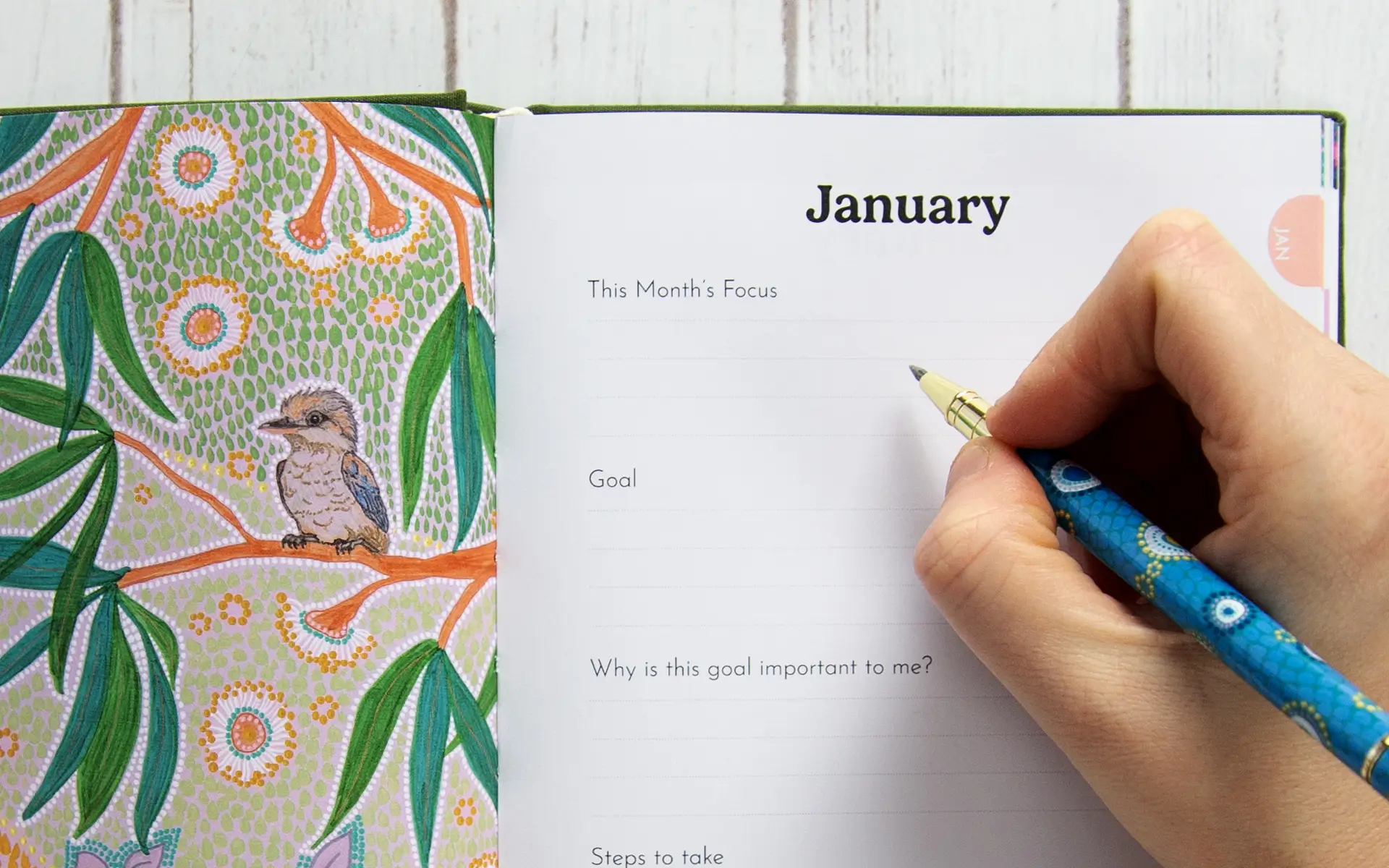
- Monthly Focus, Create a focus each month and set your goals. Outline the steps you'll take to achieve them, and how it will make you feel when you get there.
- Free space - extra lined pages for notes, so you can journal, sketch or list-make in whichever style suits you (our planner community consistently tells us lined pages are their free-space favourite, so we've made sure there's plenty)
- Lay-flat binding, so it stays open on your desk, kitchen bench, or lap without a fight
- Mindfully Made from 100% recycled, 100gsm paper, eco-friendly pages that are thick enough to write in without your favourite pen bleeding-through, a compostable, 100% cotton ribbon to mark your place and a compostable cotton-hemp fabric cover, that's durable enough to carry your planner through the year ahead.
It's a planner built for people who want their stationery to reflect their values as much as their schedule.
Step 1: Start with the Yearly Overview, dream a little before you plan
Don't open your planner at "today." Open it at the Yearly Overview first.
This is your space to zoom out before you zoom in, to jot down key dates, milestones, and the things that matter most to you in 2027 before the daily noise takes over. One planner user told us they wished they made time each new year to "outline the shape of the year" before diving into the details. That's exactly what the Yearly Overview is for - creating your mood board for the year ahead to give every month that follows a sense of direction.
Step 2: Set a Monthly Focus instead of a giant resolution
Big New Year's resolutions tend to fizzle by February. Instead, use the Monthly Focus page at the start of each month to set one clear intention, outline a few simple steps to get there, and, importantly, note how achieving it will feel.
This is a far gentler way to build momentum than trying to overhaul your whole life on January 1st, and it gives you twelve fresh starts across the year instead of just one.
Step 3: Use the Monthly Calendar Spread to plan ahead, not catch up
One of the most common struggles we heard from our planner community was "leaving things to the last minute." The Monthly Calendar Spread is your fix for this. It lets you see the whole month at a glance, so you can spot the busy weeks coming and plan around them, rather than being surprised by them.
Try flicking forward at the start of every month to pencil in birthdays, appointments and deadlines before the month even begins.
Step 4: Let your Weekly Spread hold everything in one place
Sticky notes on the fridge. Reminders in three different apps. A list on the back of a receipt. Sound familiar? Several of our planner users told us their biggest challenge was simply "writing it all down in one space."
Your Weekly Spread is designed to be that one space, with equal room for weekdays and weekends, because rest and life admin deserve just as much planning as the work week. Pair it with the Weekly Priorities & To-Do List to separate "what truly matters this week" from the never-ending background list of tasks.
Step 5: Make filling it in a tiny ritual, not a chore
This is the single biggest difference between a planner that lasts the year and one that stalls in February: a small, repeatable habit.
A few ways our planner community make it stick:
- Keep your planner somewhere you'll see it, on the kitchen bench, your desk, or in the bag you use daily
- Pair planning with something you already do, like your morning coffee or Sunday wind-down
- Use the cotton ribbon and coloured tab guides to always return to your current page, so opening it never feels like a search
- Keep it short, even 60 seconds of writing down tomorrow's top three things counts
Step 6: Get more from your Habit Tracker
The Habit Tracker is brilliant for nudging new routines into place, and just as good for quietly retiring habits you've outgrown. A few tips to get the most from it:
- Start with one habit at a time. Trying to shift too many of your behaviours at once is one of the fastest ways to abandon it altogether
- Track the action itself, not the outcome, "moved my body" is easier to tick off honestly than "got fitter"
- Don't aim for a perfect, unbroken row. A few gaps are still proof of progress, not a reason to start over
- Review it at the end of the week rather than judging each day on its own, patterns matter more than any single tick
- Feel free to swap a habit out the moment it stops serving you. The tracker should work for you, not the other way around
Step 7: Let the Weekly Gratitude prompt do its quiet work
Even taking just one quiet moment each week to write down what you're grateful for has been shown to ease stress and lift your mood, making it one of the simplest, lowest-effort habits in the whole planner.
And a quick note the Habit Tracker and Gratitude prompt: if either one feels like pressure to do, it's completely fine to skip it. Plenty of our planner community use their diary purely for daily logistics, and that's a perfectly valid way to plan too. The best planning system is the one you'll actually keep using.
Step 8: Free Space for everything else
Every month includes two extra lined pages for exactly the things that don't fit anywhere else: meeting notes, a holiday packing list, a birthday gift idea, or simply an overflow when life gets busier than your weekly grid allows.
Think of these pages as permission to be a little messy. A missed week in your weekly spread doesn't undo your whole year. It's just an excuse to use the free space and pick back up.
A planner that works because it's flexible
If there's one thing our planner community taught us, it's that there's no single "correct" way to use a diary. Some people live in the weekly to-do list and barely touch the yearly overview. Others use it mainly for long-term visioning and skip the daily grid altogether. Your 2027 planner is designed to cater to whichever kind of planner you are: practical, reflective, or a bit of both.
Frequently asked questions about Earth Greetings planners
What size is the Earth Greetings 2027 planner? It's A5 (22cm H x 15.5cm W), compact enough to carry daily, with plenty of room to write.
Is the Earth Greetings planner made from recycled paper? Yes. Every planner is made from 100% recycled paper which is also fully recyclable.
Does the planner lay flat? Yes, it uses a lay-flat binding so it stays open on any surface without needing to be held down.
Is Earth Greetings an Australian brand? Yes. Earth Greetings is an Australian stationery brand, with a strong focus on sustainable design and showcasing Australian nature and First Nations art.
What if I fall behind on my planner? That's exactly what the Monthly Focus pages are for. Don’t feel that it’s too late to get started with your planner. Every month is a chance to begin with a fresh focus and new intentions.
However you plan, the goal is the same: a little more calm, a little more clarity, and a planner that feels like a daily companion rather than another task on the list.
Want to get planning tips like these straight to your inbox? Become a Planner VIP